import dabest
import pandas as pd
import numpy as np
import matplotlib.pyplot as plt
import matplotlib as mpl

np.random.seed(42)

mpl.rcParams['figure.facecolor'] = '#FAF7F2'
mpl.rcParams['axes.facecolor'] = '#FAF7F2'
mpl.rcParams['font.family'] = 'serif'Getting Over ANOVA
DABEST in action: bootstrap confidence intervals and effect size estimation
Getting Over ANOVA: DABEST in Action
DABEST (Data Analysis using Bootstrap-Coupled ESTimation) replaces p-values with effect size estimation and bootstrap confidence intervals. The core question shifts from “is there a difference?” to “how much difference, with what precision, and does it matter?”
→ Learn more about the package
A Two-Group Comparison
Here is the classic scenario: control versus treated. With a t-test, you get a p-value and a binary verdict. With DABEST, you get the actual difference, its distribution, and a 95% confidence interval computed from 5,000 bootstrap resamples.
N = 30

# Simulate realistic biological variability
# e.g., feeding duration in seconds, two experimental conditions
control = np.random.normal(loc=8.5, scale=2.1, size=N)
treated = np.random.normal(loc=11.2, scale=2.4, size=N)

df = pd.DataFrame({'Control': control, 'Treated': treated})

db = dabest.load(df, idx=('Control', 'Treated'))

fig = db.mean_diff.plot(
    raw_marker_size=5,
    contrast_marker_size=8,
)

fig.axes[0].set_ylabel('Feeding duration (s)')
fig.suptitle('Cumming estimation plot: Control vs. Treated',
             fontsize=12, y=1.01, color='#2C4A6E')
plt.tight_layout()
plt.show()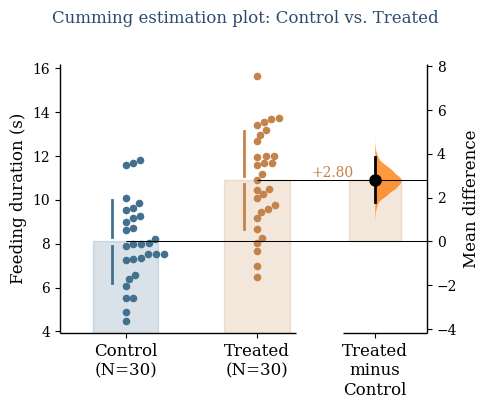
The top panel shows the raw data. The bottom panel shows the bootstrap distribution of the mean difference — not a theoretical curve, but an empirical one computed from your actual data. The filled curve is the sampling distribution; the dot is the observed mean difference; the vertical line is the 95% confidence interval.
The effect size here (~2.7 seconds, CI approximately [1.8, 3.6]) tells you something a p-value cannot: how big the difference is, and how precisely you have estimated it.
The Delta-Delta: My Original Contribution to DABEST
The delta-delta plot answers a question that ANOVA cannot: in a 2×2 factorial design, do the treatment effects differ between subgroups — and by how much, with what precision?
Standard ANOVA gives you an interaction p-value. The delta-delta gives you the effect of the effect — the difference between two differences — as an estimation graphic.
# 2x2 factorial: drug x sex (long-format data)
# The drug works strongly in males, weakly in females — does it differ?

N2 = 25
rows = []
params = {
    ('Male',   'Control'): (9.0,  2.0),
    ('Male',   'Drug'):    (12.5, 2.2),
    ('Female', 'Control'): (8.8,  1.9),
    ('Female', 'Drug'):    (10.1, 2.1),
}
for (sex, trt), (mu, sd) in params.items():
    for val in np.random.normal(mu, sd, N2):
        rows.append({'sex': sex, 'treatment': trt, 'feeding_s': val})

df2 = pd.DataFrame(rows)

db2 = dabest.load(
    df2,
    x=['treatment', 'sex'],
    y='feeding_s',
    experiment='sex',
    delta2=True
)

fig2 = db2.mean_diff.plot(
    raw_marker_size=4,
    contrast_marker_size=8,
)

fig2.axes[0].set_ylabel('Feeding duration (s)')
fig2.suptitle('Delta-delta plot: does the drug effect differ by sex?',
              fontsize=12, y=1.01, color='#2C4A6E')
plt.tight_layout()
plt.show()
/Applications/anaconda3/envs/DabestNMethRevision/lib/python3.10/site-packages/dabest/plot_tools.py:2592: UserWarning: 8.0% of the points cannot be placed. You might want to decrease the size of the markers.
warnings.warn(err)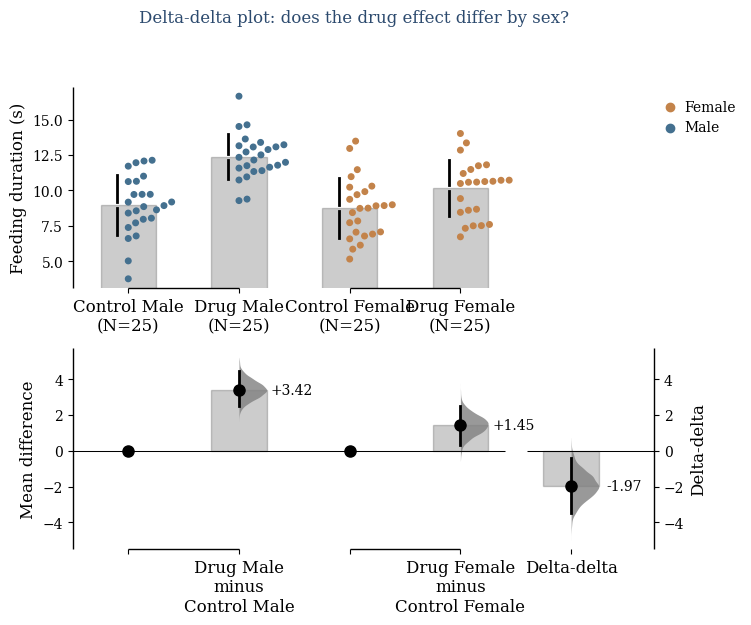
The rightmost panel shows the delta-delta — the difference between the male drug effect and the female drug effect — with its full bootstrap distribution.
An ANOVA interaction tells you whether to reject the null hypothesis of no interaction. The delta-delta tells you the magnitude of that interaction and your uncertainty about it. Those are not the same question.
Why Bootstrap?
Most confidence intervals assume your data follows a specific distribution (usually normal). Bootstrap doesn’t. Instead:
- Sample your data with replacement, 5,000 times
- Calculate the difference in means each time
- The distribution of those 5,000 differences is your confidence interval — empirically, not theoretically
This makes the intervals more honest for biological data, which is rarely perfectly normal. It also makes the uncertainty visible — a wide bootstrap distribution means you need more data. A narrow one means you have estimated the effect well.
Adoption
The original DABEST paper (Nature Methods 2019) has 2,000+ citations and has been adopted across Drosophila labs, zebrafish labs, and increasingly in clinical research. DABEST 2.0 adds the delta-delta, the proportional difference, and the mini-meta analysis — tools for the multi-group, multi-experiment designs that are now standard in biological research.
The broader point: p-values answer a binary question. Effect size estimation answers a quantitative one. Science needs quantitative answers.